What changes the scope of a chimney repair
Two chimneys with a similar-looking crack can need very different repairs. Here are the real factors — access, materials, structure and permitting — that actually change the scope of the work, without a single price attached to any of them.
Published
One of the most common questions we hear before ever seeing a chimney in person is some version of “how much will this cost” — understandable, and also a question we cannot honestly answer over the phone, because the honest answer depends on factors that only become clear during an actual inspection. What follows is not a price list, because we do not publish one, and prices change based on conditions that no article can account for in advance. It is instead a plain account of the real factors that change how big a repair job actually is, so the reasoning behind a written scope makes sense once you see it.
Access is the factor people underestimate most
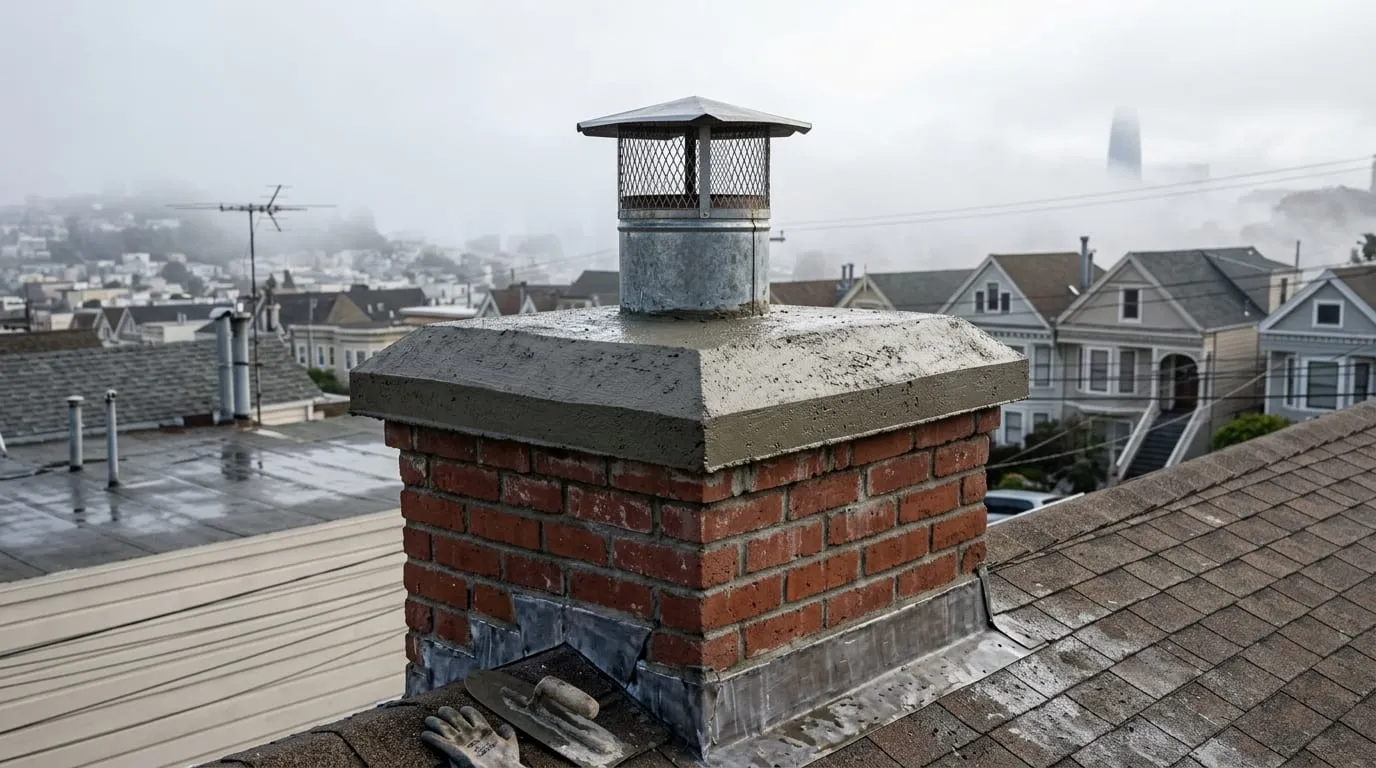
A chimney on a simple, single-story roof with clear ladder access is a fundamentally easier job than the same repair on a steep, multi-story Victorian rowhouse with limited roof access from a narrow San Francisco lot. Scaffolding, additional safety equipment, or simply the extra time it takes to work carefully on a difficult roof pitch all add real time to a job, independent of how large the actual masonry repair is. Two chimneys needing an identical crown repair can represent very different amounts of work once access is factored in.
What the diagnosis actually finds beneath the surface
A visible crack is a symptom, not a diagnosis. The same hairline crown crack can mean a straightforward resealing job, or it can be the visible tip of mortar deterioration that has already progressed several courses down into the chimney’s body, discovered only once a technician actually gets hands-on with the masonry. This is precisely why we scope a repair after a full inspection rather than from a description over the phone — the visible symptom and the underlying scope are not reliably the same size.
Matching materials to older construction
Repairing a chimney built in the past few decades generally means working with modern materials that match what is already there. Repairing a Victorian or Edwardian-era chimney, common across San Francisco’s older neighborhoods, often means sourcing or mixing a softer, lime-based mortar to match the original construction rather than simply using standard modern mortar, which behaves differently against older brick and can accelerate damage if used carelessly. That material matching adds real time and consideration to an older-home repair that a newer chimney repair simply does not need.
Structural work versus cosmetic work
A repair that stays purely cosmetic — repointing visible mortar joints, resealing a crown — is a fundamentally different scope than a repair that touches how the chimney structurally connects to the house framing. On San Francisco’s older, unreinforced masonry stock especially, a repair that includes addressing a structural-tie deficiency is doing meaningfully more than a cosmetic repointing job looks like it is doing from the ground, even when the visible symptom that prompted the call looked similar in both cases.
Whether the job needs a permit
As covered in more detail elsewhere on this site, some chimney repairs in San Francisco require a building permit and some do not, and the dividing line is what the work actually touches structurally rather than how large it sounds. A repair that needs SFDBI sign-off adds real time to the schedule that a non-permit repointing job does not need, and that timeline difference is a genuine factor in how a job gets scoped and scheduled, independent of the physical work itself.
Whether insurance is involved
A repair connected to a specific event — storm damage, a fallen tree limb, damage discovered after an earthquake — sometimes involves a homeowner’s insurance claim, and that changes the paperwork side of a job even when it does not change the physical repair itself. Insurance documentation typically calls for more detailed photographs, a more specific written description of cause and effect, and sometimes a formal report format the carrier requests, all of which add time on the front end of a job that a straightforward, non-claim repair does not need. We flag this distinction early when a repair sounds insurance-related, since it affects how the visit itself is documented from the start.
How many separate problems the inspection finds
A chimney that has gone a long time without attention often has more than one issue developing at once — a cracked crown alongside deteriorating mortar alongside a flashing seal that has failed at the roofline, each one a modest problem individually but adding up to considerably more total work when addressed together. This is part of why an inspection that checks the whole system, in the order water and structural stress actually travel, matters more than treating whichever single symptom prompted the original call.
Weather and scheduling realities
Masonry repair work, particularly anything involving fresh mortar or a poured crown, needs reasonable weather to cure properly, and San Francisco’s fog and occasional rain can affect scheduling around a repair more than a drier climate would. This does not usually change the scope of the work itself, but it can affect how a job gets sequenced and how long it takes from start to finish.
What never changes: the diagnosis comes first
Regardless of how any of these factors combine on a specific chimney, the sequence stays the same: a full inspection, a written scope explaining exactly what was found and what it requires, and only then the work itself. We do not estimate from a phone description or a photo, because the factors above are precisely the kind of thing that only becomes clear once someone is actually looking at the chimney in question.
Getting an actual scope for your chimney
If you have noticed a crack, a stain, or simply want an older chimney’s condition confirmed, we start with a full inspection and explain in writing what we find and why it matters — no verbal estimate from the driveway, and no assumption based on the age of the house alone. We work across a twenty-mile radius from central San Francisco.
Read next
More from the blog
Spark arrestor rules in wildfire-era California
A spark arrestor is not a decorative extra on a California chimney — it is a fire-code requirement with specific mesh and sizing rules, sharpened further in Wildland-Urban Interface areas. Here is what the code actually says.
Eucalyptus, Monterey pine and why Bay Area caps clog early
Eucalyptus trees, planted across the Bay Area by the thousands starting in the early 1900s, shed leathery, resinous debris essentially year-round — a genuinely regional chimney-cap problem most of the country never deals with. Here is the mechanism and the fix.
When chimney work in San Francisco needs a permit
San Francisco’s Department of Building Inspection does not require a permit for straightforward repointing, but the line moves fast once a repair touches structural framing or seismic bracing. Here is what actually triggers one.
Get a written scope
A full inspection first, then a written account of exactly what the work involves — no verbal estimate from the driveway.