
Chimney caps · San Francisco

Chimney caps and spark arrestors in San Francisco

Not sure a cap is worth it, or which one actually fits my chimney.

No obligation. Call and we’ll confirm when we can come by.

  • Most single-flue cap installations take under an hour once the correct model is on hand.
  • A properly sized, code-compliant spark-arrestor cap matched to your chimney type.
  • Roof access and, for a factory-built system, confirmation of the exact model installed.
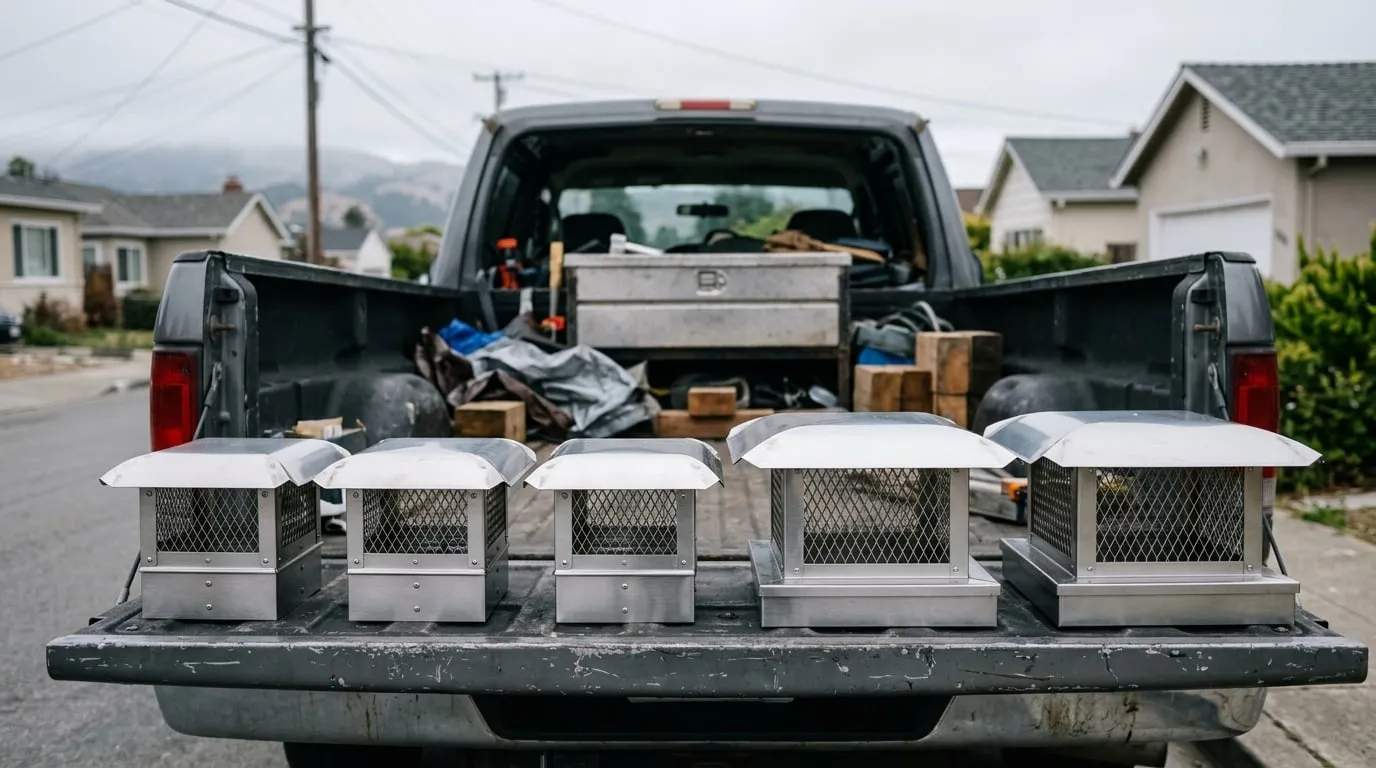
Several new stainless steel chimney caps with spark-arrestor mesh screens laid out on a work surface before installation in San Francisco

What a cap covers

What sits at the very top

The cap and spark arrestor — traced against the same cutaway every service on this site uses.

The short answer

A chimney cap keeps rain, fog drip, eucalyptus debris and nesting birds out of the flue, and a spark arrestor built into it keeps embers from an open fire from landing on a roof — a genuinely serious consideration anywhere in California’s wildfire-era building code, not a decorative afterthought. The right cap depends on what is actually on the chimney now: a factory-built system needs the exact model listed for it to keep the manufacturer’s rating and your insurance coverage intact, while a masonry chimney can generally take a properly sized universal cap with the correct mesh spacing for spark-arrestor compliance. We measure before we recommend anything, and we explain why a mismatched or missing cap is one of the cheapest problems to fix and one of the most expensive to ignore.

Cutaway of a masonry chimney: the cap and spark arrestor at the top, then the crown, the flue liner running down inside the brickwork, the mortar joints, the flashing where the stack meets the roof, the smoke chamber, and the firebox down at the hearth.01020304050607
  1. 01Cap and spark arrestor Keeps fog drip, eucalyptus debris and nesting birds out of the flue. California’s fire code sets the minimum mesh spacing for the spark-arrestor screen.
  2. 02Crown The sloped slab across the top. Coastal fog settles on it for hours at a time even on a rainless day, and that standing moisture is what opens the first crack.
  3. 03Flue liner The passage the smoke leaves by. A break in it is a safety fault, not a maintenance item.
  4. 04Mortar joints In an unreinforced pre-1940s stack this is also where a shaking chimney tends to shear first — a fact tied directly to the Bay Area’s earthquake risk, not just to age.
  5. 05Flashing The seam between stack and roof. On an older Bay Area home this seam has usually been re-tarred more than once, and a bad reseal is a common source of a slow ceiling stain.
  6. 06Smoke chamber The shelf a flue brush never reaches. When a house smells of last winter, this is usually where it is coming from.
  7. 07Firebox The only part of the whole system most people ever see — and the last place a problem turns up.

Book this if you noticed

The usual signs

  • No cap at all, or a visibly rusted, bent or missing one.
  • Birds, leaves or eucalyptus debris regularly found in the firebox or flue.
  • A universal cap that clearly does not fit the flue opening cleanly.
  • You are in or near a Wildland-Urban Interface area and are not sure your setup is compliant.

Not sure your cap needs replacing? Call (628) 245-1261 and describe it — we will point you to the right service.

What is included

Cap installation, scoped plainly

Included

  • Measurement and system identification before any cap is recommended
  • A cap matched to your chimney type, with code-compliant spark-arrestor mesh
  • Removal and inspection of the crown or chase top underneath the old cap
  • Installation, sealing and a final level-and-seat check

Not included

  • Crown repair or rebuilding, quoted separately if the removal reveals damage underneath
  • Full chase-pan replacement on a factory-built system, quoted as its own job if needed

Crown repair underneath an old cap is a separate service, quoted on its own so a cap job never turns into a surprise bill.

The visit

How a cap installation actually goes

  1. 1

    Measure and identify the system

    We measure the flue opening and confirm whether the chimney is masonry or factory-built before recommending a cap.

  2. 2

    Match the correct model

    A factory-built system gets the manufacturer-listed cap for that exact model; masonry gets a properly sized cap with compliant mesh spacing.

  3. 3

    Remove and inspect the old cap

    Any existing cap is removed, and the crown and flue opening underneath are checked while it is off.

  4. 4

    Install and seal

    The new cap is fitted, sealed against the crown, and secured against wind.

  5. 5

    Final check

    We confirm the cap is level, properly seated and clear of debris before we consider the job done.

Several new stainless steel chimney caps with spark-arrestor mesh screens laid out on a work surface before installation in San Francisco

Spark-arrestor specifications

Caps and arrestors, by the numbers

The figures a spark-arrestor cap is actually held to under California’s fire code, not a rule of thumb.

Net free area
At least 4× the flue’s net free area
Mesh opening size
3/8 in. to 1/2 in.
Corrosion resistance
19-gauge galvanized or 24-gauge stainless
Accessibility
Removable for flue cleaning, per code
Applies to
Every masonry and factory-built chimney with a fitted arrestor

California Building Code Chapter 7A and local Wildland-Urban Interface fire-code adoptions covering spark-arrestor mesh.

In detail

Why the right cap depends on what is underneath it

Factory-built systems, masonry chimneys, and why California’s wildfire-era code and the Bay Area’s own trees both change what a cap needs to do.

01What a cap actually does, beyond keeping rain out

A chimney cap has two separate jobs that get lumped together as one. The first is weatherproofing: keeping fog drip, rain, and — across much of the Bay Area — falling eucalyptus and pine debris out of an open flue, where any of it can obstruct airflow or add fuel to accumulated creosote.

Continue reading

The second, built into the same fixture through a mesh spark-arrestor screen, is fire safety: stopping embers from an open wood fire from escaping the flue and landing on a roof or in dry vegetation nearby. In California, that second job is not optional in most jurisdictions — spark-arrestor mesh on an open masonry fireplace or wood-stove chimney is a fire-code requirement, sized specifically to the flue’s own net free area so it blocks embers without restricting draft.

02Why the right cap depends on what is underneath it

Not every chimney takes the same cap, and getting this wrong is one of the most common, and most consequential, mistakes we correct.

Continue reading

A factory-built, zero-clearance fireplace system was engineered and safety-listed as a complete unit, cap included — fitting a generic universal or masonry-style cap on top of one can void the manufacturer’s UL listing outright, and with it, potentially, the homeowner’s insurance coverage in the event of a fire. A traditional masonry chimney has more flexibility, but still needs a cap sized correctly to its actual flue opening, with mesh spacing that meets the fire-code figures rather than whatever happened to be on the shelf. We measure the flue and identify the system before recommending anything — never the other way around.

03The Bay Area’s own debris problem

Eucalyptus and Monterey pine are two of the most common large trees across San Francisco and the wider Bay Area, both introduced species that now shape the region’s tree canopy in neighborhoods from the Presidio to the Oakland and Berkeley hills.

Continue reading

Both sheds constantly rather than in one seasonal drop — eucalyptus in particular drops bark strips, leathery leaves and resinous debris essentially year-round. On an uncapped or poorly capped chimney, that debris finds its way into the flue steadily rather than in a single autumn burst, and it combines with fog moisture to create a denser, stickier buildup than dry leaf litter alone would. A properly fitted cap with the right mesh spacing keeps essentially all of it out, which is a meaningfully bigger practical benefit here than in a region without these particular trees.

04Fog, salt air and why the cap material matters

Coastal fog and, closer to the shoreline and the refineries around Richmond, some additional airborne salt and particulate exposure both accelerate corrosion on an exposed metal cap faster than the same fixture would age in a drier, inland climate.

Continue reading

That is part of why we favor stainless steel or heavier-gauge galvanized construction over the lightest, cheapest cap options — a cap that corrodes through in a few years, rather than lasting a decade or more, is a false economy once the labor of a second installation visit is factored in.

05What changes the job, and what does not

A single, accessible flue with a straightforward opening is the baseline job — measure, match, remove the old cap, install and seal the new one, done in under an hour.

Continue reading

Multiple flues, an unusually tall or hard-to-reach chase, or a crown that turns out to need repair once the old cap comes off can extend the visit, and we will tell you plainly if that is the case before continuing. What never changes is the sequence: measure and identify the system first, recommend a cap second — never the reverse.

06Booking a cap installation in San Francisco and the Bay Area

Whether your chimney has never had a cap, has an old one that is rusted or clearly mismatched, or you simply want confirmation that your current setup is fire-code compliant, we start with a measurement and a straight answer about what your chimney actually needs.

Continue reading

We work across a twenty-mile radius from central San Francisco.

Reviews

What the last 17 customers actually said

5.0

17 Google reviewscounted 2026-08-26

  • 517
  • 40
  • 30
  • 20
  • 10
  • Jennifer Garcia

    Heavy Stage 3 creosote had built up within an inadequately sized flue pipe, but a vigilant technician cleaned it away, preventing catastrophic fire dangers.
  • Miguel Reynolds

    Last winter we got a weird burning smell every time we used the fireplace. They cleaned a thick coating of soft creosote from the higher tiles and the stench is completely gone now.
  • Leonardo Madden

    Most sweepers only glance up with a flashlight. This team established a thorough monitor and pointed out minor gaps in the mortar parging, and brushed the smoke chamber till it appeared brand new.
  • Rhiannon Wimer

    Punctual, polite, and thoroughly professional. They treat your home with total respect and deliver world-class service every single time.

Read all 17 reviews on Google

Questions

What people ask about caps

Does California’s wildfire code actually require a spark arrestor on a residential chimney?

Yes, in Wildland-Urban Interface areas and under the state fire code generally — an open masonry fireplace or wood stove chimney needs a compliant spark-arrestor mesh cap, and we size it to the net-free-area and mesh-opening requirements rather than guessing.

Can any cap fit my factory-built fireplace?

No — a factory-built system needs the cap model listed for it specifically. Fitting a universal or masonry-style cap can void the manufacturer’s UL listing and your homeowner’s insurance coverage, which is one of the most common mismatches we correct.

Why does eucalyptus debris matter for a Bay Area chimney cap?

Eucalyptus and Monterey pine, both common across the Bay Area, shed resinous leaf litter and bark year-round rather than in one seasonal drop, and that debris clogs an undersized or poorly sealed cap faster than it would in a region without those trees.

How do I know if my current cap is actually code-compliant?

We measure the mesh opening and net free area against the current fire-code figures during the visit — a cap that looks fine from the ground can still have mesh spacing too wide or too narrow to be compliant.

Is a cap really worth it if my chimney has gone years without one?

Almost always, yes — an uncapped flue lets in fog drip, debris and animals continuously, and the cost of a cap is small compared to the crown, liner or nesting-related repair an uncapped chimney eventually needs.

Book a cap installation

Tell us what is on your chimney now, if you know — we will confirm the right cap.

Or call (628) 245-1261 to book directly.

Tell us what changed.

Tell us what the fireplace is doing and what changed. Someone reads every message that comes in.

No obligation. Call and we’ll confirm when we can come by.

Prefer to talk? Call (628) 245-1261 — we’ll confirm when we can help.