
Spark arrestor rules in wildfire-era California
A spark arrestor is not a decorative extra on a California chimney — it is a fire-code requirement with specific mesh and sizing rules, sharpened further in Wildland-Urban Interface areas. Here is what the code actually says.
Published
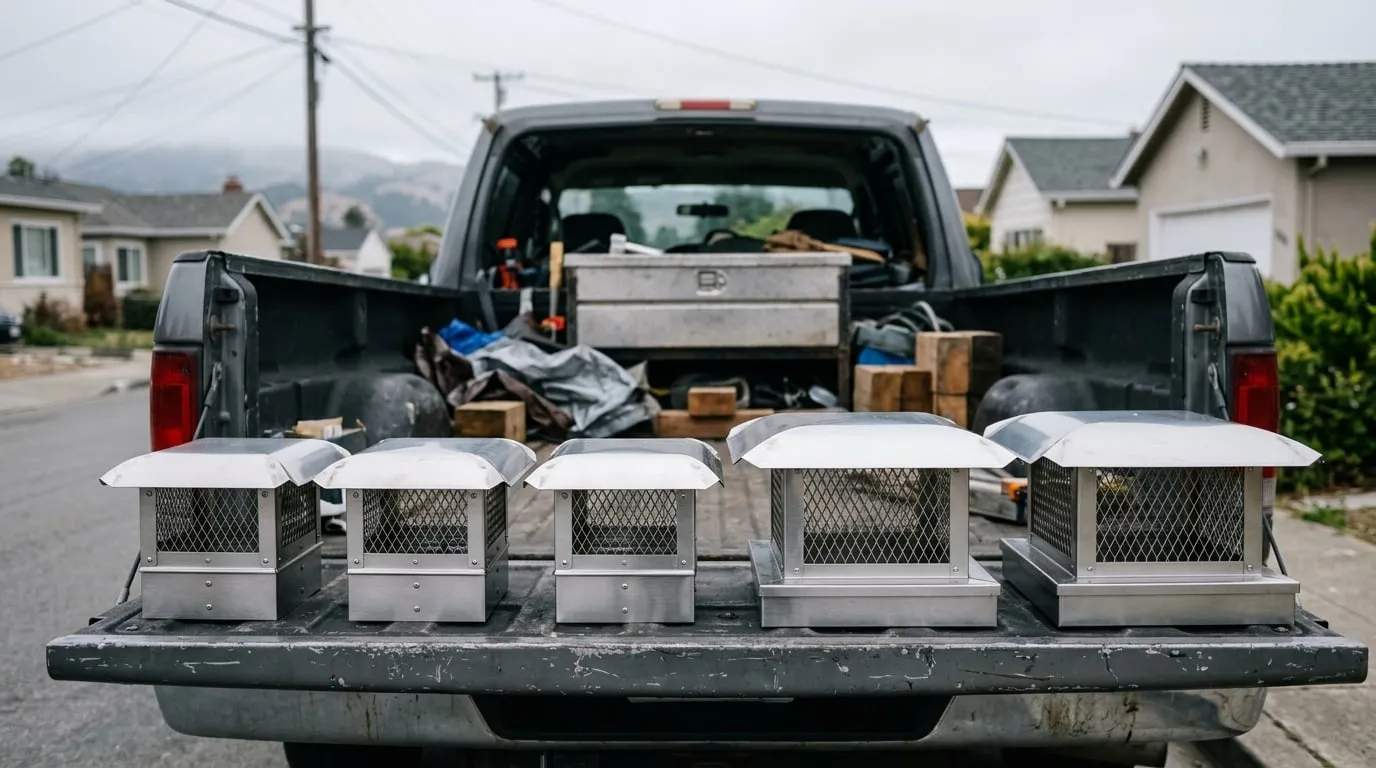
California’s relationship with wildfire risk has reshaped a lot of building code over the past couple of decades, and chimney spark arrestors sit squarely inside that shift. What used to be treated in many places as a simple accessory — a cap that keeps rain and birds out — carries real, specific fire-code weight here, and the requirements sharpen further for any property inside a designated Wildland-Urban Interface, or WUI, area.
What a spark arrestor is actually for
An open, wood-burning fireplace or stove sends embers up the flue along with the smoke, and without something stopping them, those embers can exit the chimney top and land on a roof, in dry vegetation, or on debris nearby — a genuine ignition risk that California’s dry summer and fall conditions turn from theoretical into a real, recurring cause of structure fires. A spark arrestor is a mesh screen, built into or fitted onto the chimney cap, sized specifically to block embers from escaping while still allowing enough airflow for the fireplace or stove to draw and vent properly.
The specific numbers the code sets
This is not a vague “install some kind of screen” requirement. California’s building code, drawing on the state fire marshal’s regulations and Chapter 7A’s wildfire-specific provisions, sets concrete figures: the mesh openings on a spark arrestor typically need to fall between roughly three-eighths and one-half of an inch — small enough to stop embers, large enough not to choke draft or clog immediately with debris. The screen’s total open area needs to be several times the flue’s own net free area specifically because a fine mesh screen inherently restricts airflow more than an open flue does, and a spark arrestor sized without that multiplier can create a serious draft problem even while doing its ember-blocking job correctly. The mesh material itself needs to be corrosion-resistant — typically 19-gauge galvanized steel or a lighter-gauge stainless steel — and the entire arrestor assembly needs to be removable, since a permanently sealed spark arrestor would make normal flue cleaning impossible.
Wildland-Urban Interface areas raise the stakes further
A WUI designation applies to areas where development sits close enough to wildland vegetation that a wildfire could realistically threaten structures directly, and California has mapped these zones extensively, particularly across the hillside and canyon-adjacent parts of the wider Bay Area. Properties inside a mapped WUI zone can face additional requirements beyond the baseline spark-arrestor rule — sometimes including ember-resistant venting details elsewhere on the structure, not just at the chimney. Even for a property just outside a formally mapped WUI boundary, the underlying fire risk that justified the mapping does not stop cleanly at a line on a map, which is part of why a properly sized, code-compliant spark arrestor is worth having regardless of which exact side of a boundary a given address happens to fall on.
How this interacts with insurance
Homeowner’s insurance carriers in California have become considerably more attentive to wildfire-adjacent risk factors over the past several years, and a documented, code-compliant spark arrestor is one of the more straightforward, affordable things a homeowner can point to as an active risk-mitigation measure. Conversely, a missing or clearly non-compliant spark arrestor on an active wood-burning fireplace is the kind of detail that can complicate a claim, or in some cases a policy renewal, if it becomes relevant after an incident. This is not a reason to panic about an older cap, but it is a reasonable, practical argument for confirming compliance rather than assuming an existing cap already meets the current figures.
What this means for a factory-built system specifically
A factory-built, zero-clearance fireplace or wood stove was engineered and safety-listed as a complete unit, spark arrestor included, and the manufacturer’s own listed cap is what keeps that whole system’s rating — and by extension its insurance standing — intact. Swapping in a generic universal spark-arrestor cap on a factory-built system, even one that technically meets the mesh-spacing figures, can void the manufacturer’s listing outright. The correct approach on a factory-built system is always the manufacturer-specified replacement part, not a universal substitute, however compliant that substitute looks on paper.
Finding out whether your address sits in a mapped WUI zone
CAL FIRE publishes Fire Hazard Severity Zone maps covering the whole state, and most Bay Area counties and cities also maintain their own local hazard overlays that can be stricter than the state baseline in specific hillside or canyon-adjacent pockets. A property does not need to look like it borders open wildland to fall inside a mapped zone — the maps are drawn from vegetation, slope and historical fire-spread data, not from a visual impression of how close the nearest tree line is. Checking your specific address against the current map, rather than assuming based on how the neighborhood looks, is the only reliable way to know which set of requirements actually applies, and it is a five-minute check worth doing before assuming either that you are covered or that you are exempt.
Checking your current setup
A cap that looks intact from the ground can still have mesh spacing outside the current code figures, corrosion working from the inside out, or simply be the wrong type for the chimney underneath it. Confirming actual compliance means measuring the mesh opening and the net free area directly, and confirming whether the chimney is masonry or factory-built before recommending any replacement. If it has been years since anyone looked closely at your chimney’s cap and arrestor, that is a quick, inexpensive thing to have checked — considerably cheaper than the fire risk or the insurance complication a genuinely non-compliant setup can create.
Booking a cap and spark-arrestor check
We measure before we recommend, and we will tell you plainly whether your current setup already meets the current figures or needs a replacement. We work across a twenty-mile radius from central San Francisco, covering both coastal fog-belt properties and the hillside, WUI-adjacent areas further inland.
Read next
More from the blog
Eucalyptus, Monterey pine and why Bay Area caps clog early
Eucalyptus trees, planted across the Bay Area by the thousands starting in the early 1900s, shed leathery, resinous debris essentially year-round — a genuinely regional chimney-cap problem most of the country never deals with. Here is the mechanism and the fix.
When chimney work in San Francisco needs a permit
San Francisco’s Department of Building Inspection does not require a permit for straightforward repointing, but the line moves fast once a repair touches structural framing or seismic bracing. Here is what actually triggers one.
What San Francisco’s fog actually does to a chimney
A San Francisco chimney can corrode and crack on a week with zero measurable rainfall, because the coastal fog rolling through the Golden Gate behaves nothing like a rainstorm. Here is why fog-hours matter more than rain totals, and where to look first.
Get your cap checked
We measure the mesh and net free area against the current code figures before recommending anything.